Produced from stills and audio recorded during the inaugural Talbot Avenue Bridge Lantern Walk.
Blog

2018 Lantern Walk: Photos and Recap
About 50 people met at the Talbot Avenue Bridge at dusk on Saturday November 10, 2018 to participate in the inaugural Talbot Avenue Bridge Lantern Walk. This Little Light of Mine was the event’s theme.
The day began with a morning lantern making workshop which was held at the Gwendolyn Coffield Community Center. People from age two to 99 made lanterns using recycled plastic bottles, paper, leaves, and twigs.
Lantern-Making Workshop Photo Gallery
Andrea Blackford of The Washington Revels’ Jubilee Voices led people in song and representatives from the Lyttonsville, North Woodside, and Rosemary Hills neighborhoods made brief statements before walkers embarked on a route over the bridge and through the North Woodside and Lyttonsville neighborhoods. At the end of the route, people gathered for hot cider and baked goods.Lantern Walk Photo Gallery
This Little Light of Mine VideoPop-Up Museum Returns During Centennial
The Invisible Montgomery Talbot Avenue Bridge pop-up museum returns to the bridge during the centennial celebration. Last spring the pop-up museum debuted with interpretive panels placed along the bridge. The panels included photos and text documenting Lyttonsville’s history and the roles that the bridge and railroad tracks played in the community.
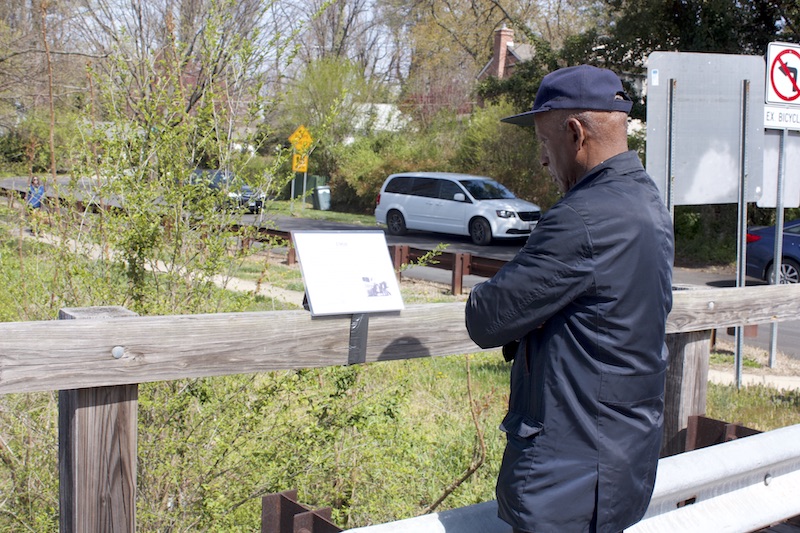
This iteration of the pop-up museum expands the history covered in the first exhibition. During the 1960s there were several major civil rights actions, including demonstrations, that took place within a short walk from the bridge. Also within walking distance, some of Silver Spring’s earliest observant Jewish communities were established.
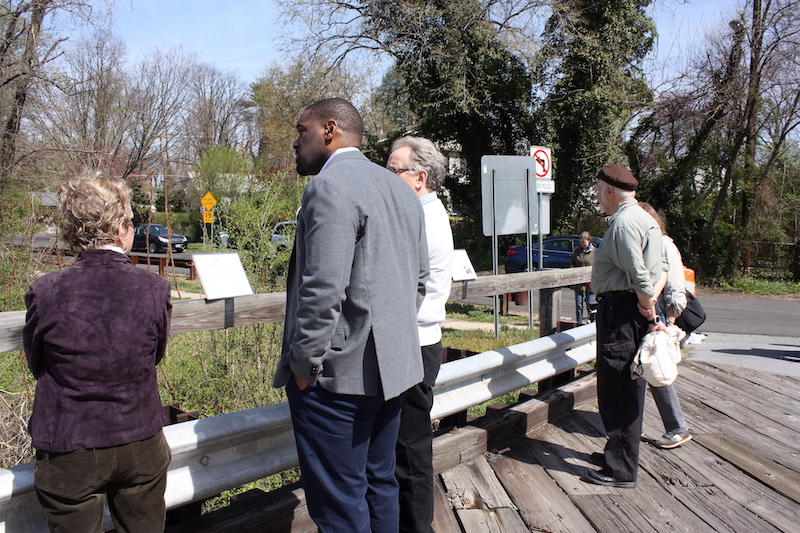
In addition to the history panels, there also will be an oral history listening station where visitors can hear residents from Lyttonsville and North Woodside narrating some of their memories of the bridge. Do you have a story or thoughts about the bridge to share? Leave them on notecards in one of the interactive exhibits.

Check out our FAQ for more information about the centennial celebration. The pop-up museum will be open throughout the event, from 2:00 p.m. to 5:00 p.m.
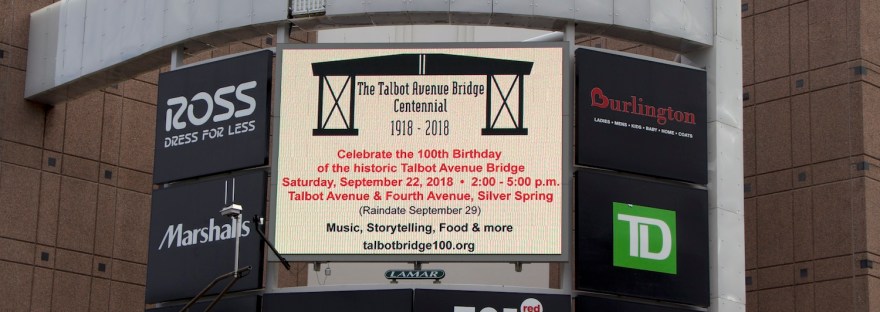
The Bridge in Bright Lights
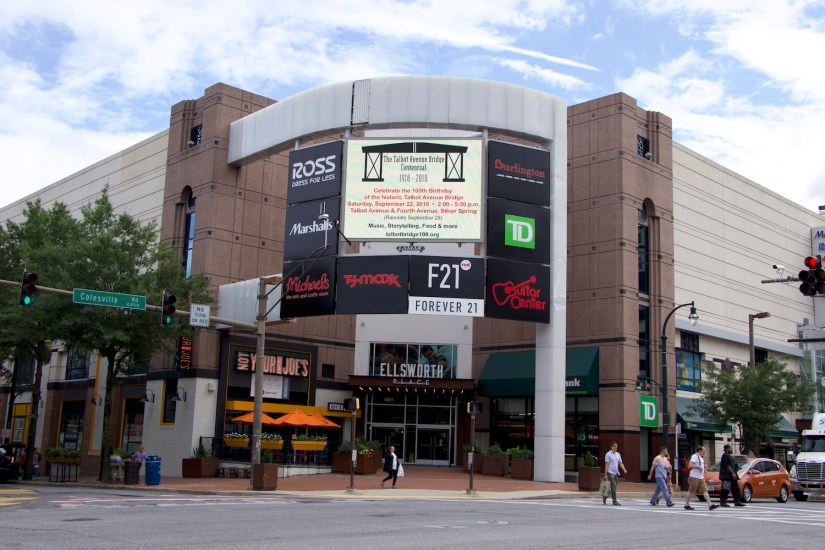
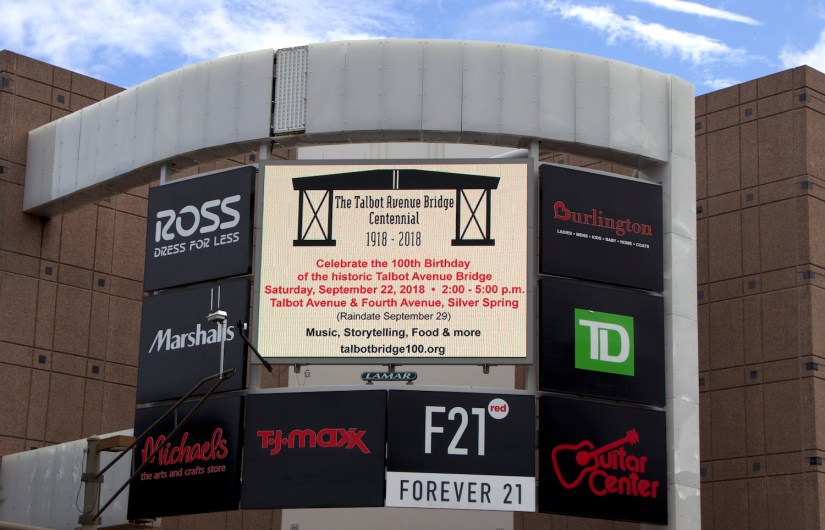
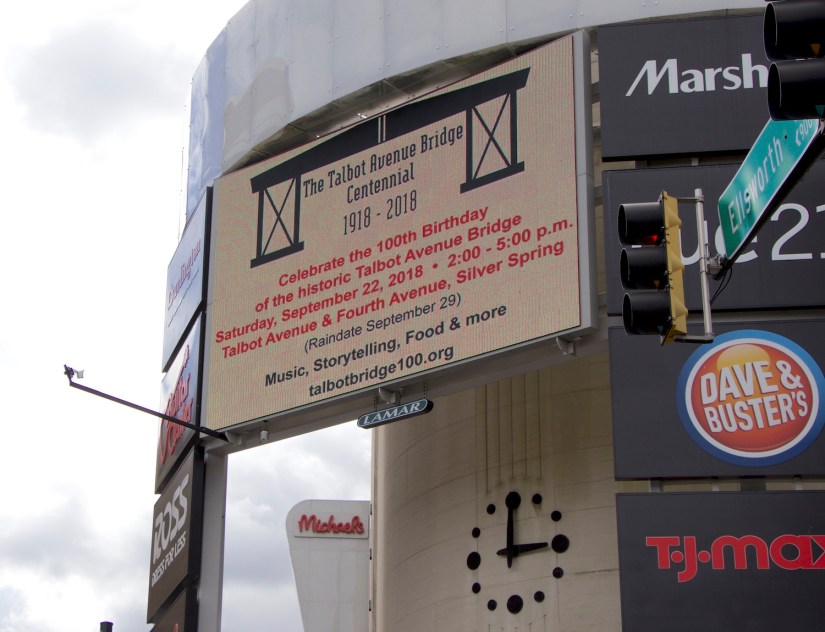
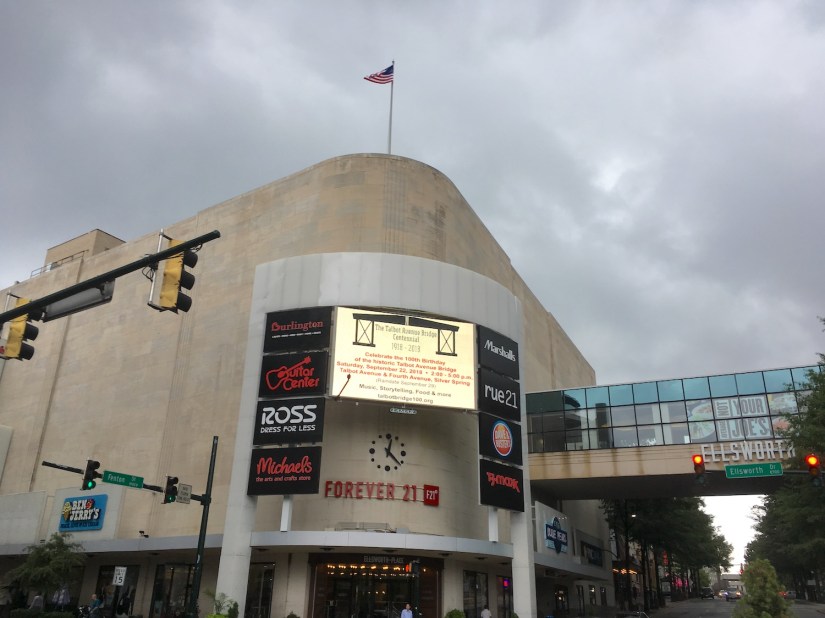
Thank you to Reemberto Rodriguez, Director of the Silver Spring Regional Center, for arranging to have the Talbot Avenue Bridge Centennial featured on downtown Silver Spring’s “jumbotron” displays. The slide was designed by planning committee member Eva Santorini.
Meet Emcee Dr. Ella Redfield
Pastor Ella Redfield and the Talbot Avenue Bridge have a long shared history. Dr. Redfield spent many years growing up and living in Lyttonsville. The bridge was her major link to the outside world. “That was the bridge we used. There [were] only a few ways to get to the wider community, you know, to get to the stores, to get to transportation,” Dr. Redfield recalled in a 2016 interview. “I remember walking through the neighborhood, and of course past the house that I grew up in, walking to and crossing that bridge to catch a bus to go downtown to the Department of Treasury where I worked.”
Dr. Redfield lived in Lyttonsville in the years before Montgomery County paved the roads and installed other essential infrastructure like water and sewer service. “When I would go to work my shoes would be muddy. I hated those rainy days because you couldn’t walk the streets without [getting muddy],” she explained.
Dr. Redfield’s family has lived in Montgomery County for more than a century. Like many African Americans who lived in Montgomery County during Jim Crow, she was born at Freedman’s Hospital (now Howard University). Giving birth was in some respects like shopping for clothes, getting your hair done, going to a movie, or eating at a restaurant, Montgomery County Blacks mostly had to go into the District if they could get there and afford it. “When we shopped, you know, when we went to shop for school or whatever, we went to the city. Because there was no place in Silver Spring for us to go,” Dr. Redfield said. “We were living in Linden [Lyttonsville] and we were closer to D.C. so when my mother had me, she had to go to Freedmen’s Hospital. So, you know, you couldn’t go to Suburban Hospital.”
Dr. Redfield’s mother, Estelle Lomax Green, had family with deep roots in the Wheaton Lane community, a small hamlet founded by African Americans in the 1870s south of University Boulevard between Wheaton and Four Corners.
Wheaton Lane was a lot like Lyttonsville. It had no paved streets or other infrastructure and it was a community with strong kin, church, economic, and social network ties to Montgomery County and Washington’s other Black neighborhoods and hamlets. And, in the 1970s, like Lyttonsville it was one of the communities Montgomery County targeted for its Community Renewal Program (also known as “urban renewal”).
For all intents and purposes, during most of the twentieth century there were two Montgomery Counties. “The irony is the white people our ages, most of them were oblivious to what was going on,” Dr. Redfield recalled in a 2018 interview. “No trespassing or ‘members only’ and the thing about it, we all knew our place. We would go to the deli, we knew we could order from the counter. In fact, we could go to the deli in Montgomery Hills, Steve’s. I had no idea they had a little restaurant back there.”
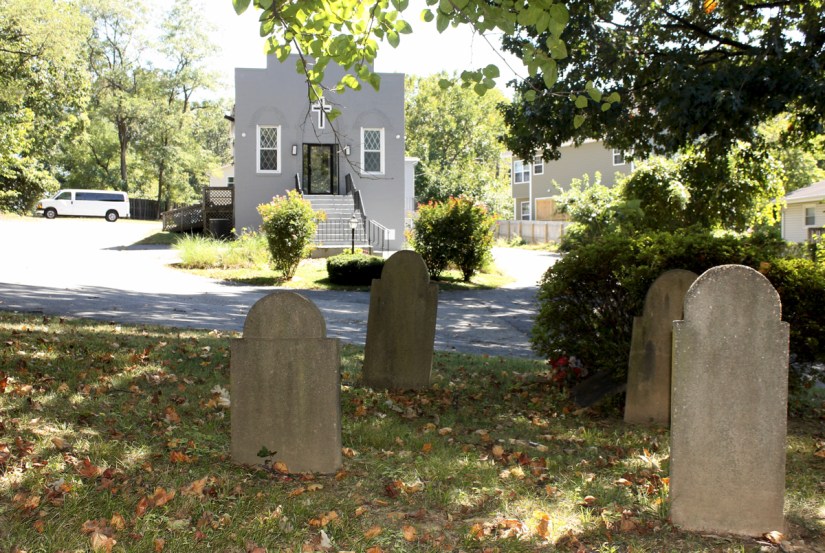
The family’s church, Allen Chapel A.M.E., had been founded in 1870. The congregation in 1873 built a church in-between Wheaton Lane and what became downtown Wheaton; some of Dr. Redfield’s ancestors are buried in the small graveyard there. When her mother moved to Lyttonsville, they attended Mt. Zion Methodist Church on Georgia Avenue (the site later was occupied by a Safeway and Staples; it’s now an Aldi supermarket). “The church sat up on the hill, right there on Georgia Avenue. And the church people sold the property and they moved to Van Buren Street in Washington, D.C.,” Dr. Redfield said.
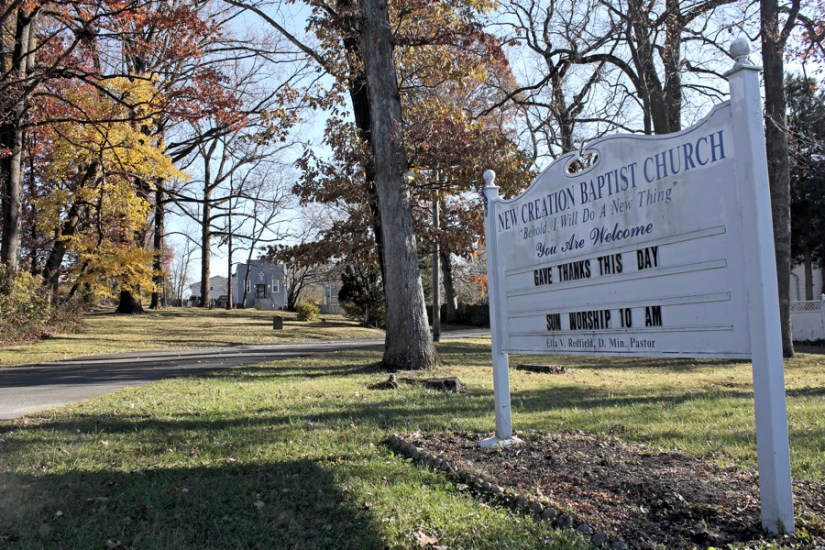
Dr. Redfield was able to buy the historic church property and use it for the church that she founded in 1994 after completing seminary studies, the New Creation Baptist Church. In 2001, Allen Chapel A.M.E. Church moved to Silver Spring’s Fairland community.
Dr. Redfield briefly lived in Kensington as a child before her mother moved back to Lyttonsville, to the same home her mother had rented earlier. “We stayed there pretty much until I became grown,” she said.
Though Lyttonsville was enveloped by a county firmly gripped by Jim Crow, the residents there and in places like Ken-Gar, River Road, and Scotland created spaces and events that left lasting positive memories. “I do remember is we had some good times in the community. We really did,” Dr. Redfield recalled. “In these black communities … We had parties. We had house parties, you know. That’s how we had our entertainment, we had house parties and everybody was invited to the house party.” In Wheaton Lane, the Hyson family had a little dance pavilion — just like Samuel Lytton did in Lyttonsville before he died in 1893. And in Lyttonsville after World War II, there were certain homes where folks knew they could go to dance and do other things to unwind.
Back when Dr. Redfield lived in Lyttonsville most folks still called it “Linden.” The bridge is the only material link to Lyttonsville’s past. “The only thing that I can see in terms of historic is that bridge. Because a lot of the homes have been rebuilt. And of course the church certainly is not historic because the church moved there some time ago but it’s not historic,” she said. “The oldest thing there is that bridge.”
Dr. Redfield attended Montgomery College before continuing her studies at Washington Bible College and Howard University. Her degrees include a Master of Divinity and Doctor of Ministry from Howard University School of Divinity. Dr. Redfield served on the Professional Advisory Committee of the National Institutes of Health Spiritual Ministries Chaplaincy Program and she has taught at Howard University and Wesley Theological Seminary.
Dr. Redfield brings her intimate knowledge of the community and the bridge, plus her storytelling skills to the Talbot Avenue Bridge Centennial program. Dr. Redfield will speak about the bridge and Lyttonsville’s history and she will introduce our musical acts and other speakers.
 The Talbot Avenue Bridge